Input Image
The source image is loaded and prepared for preprocessing.
A computer vision project built with OpenCV to detect circular coin objects from images using preprocessing, edge-based analysis, morphological operations and geometric detection.
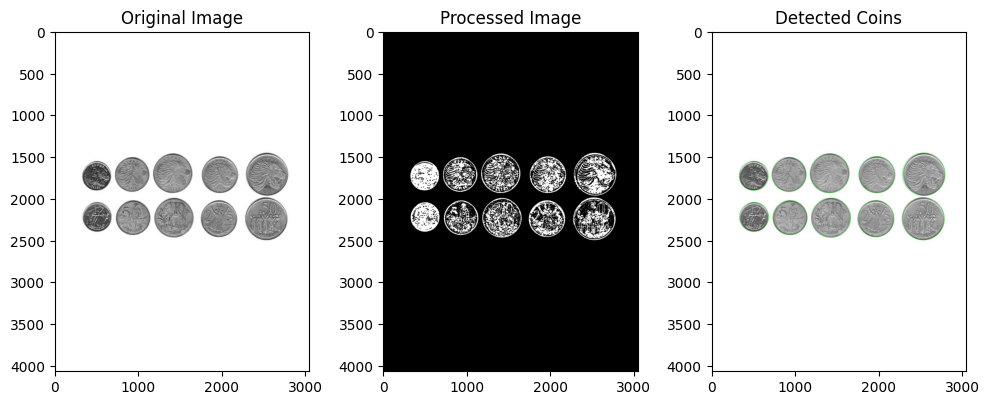
The project explores how classical computer vision can convert an image containing physical coins into machine-readable information.
Instead of relying on a trained deep learning model, the system uses a deterministic image-processing pipeline. Noise is reduced, object boundaries are emphasized, and circular geometry is analyzed to identify candidate coins.
The system uses a multi-stage processing pipeline to progressively reduce visual noise and improve the quality of circular object detection.
The source image is loaded and prepared for preprocessing.
Reduces image noise and smooths small visual irregularities.
Separates foreground objects under varying local lighting conditions.
Erosion and dilation improve object boundaries and remove small artifacts.
Circular candidates are identified using geometry-based detection.
Once candidate circles are detected, the system marks them directly on the image. This makes the output easier to inspect and helps evaluate whether the preprocessing pipeline isolated the intended coin boundaries.
s
Adaptive thresholding allows the preprocessing stage to respond to local brightness differences, helping separate coins from the surrounding background.
The system focuses on circular geometry rather than semantic recognition, making it a classical computer vision solution.
Erosion and dilation are used to refine binary masks, reduce small artifacts and strengthen useful contours.
The interface guides users toward clearer coin placement, helping reduce detection errors caused by overlap or poor object positioning.
Every transformation can be inspected, making it easier to understand why a detection succeeds or fails.
The system relies on image structure and geometry rather than model training.
Thresholds and preprocessing parameters can be adjusted rapidly to study the effect on detection results.
This project became an early exploration of how deterministic image-processing techniques can transform raw visual input into usable data.